
CLAUSEDOCK GUIDES
3PL Returns Processing Fees: How to Check Your Invoice

To check 3PL returns processing fees, confirm the billing unit and charge trigger in your contract, match each invoice line to a return or carton record, and recalculate using your account's applicable rate. Keep unresolved lines outside the supported correction total, and check for reversals or credits before requesting an adjustment.
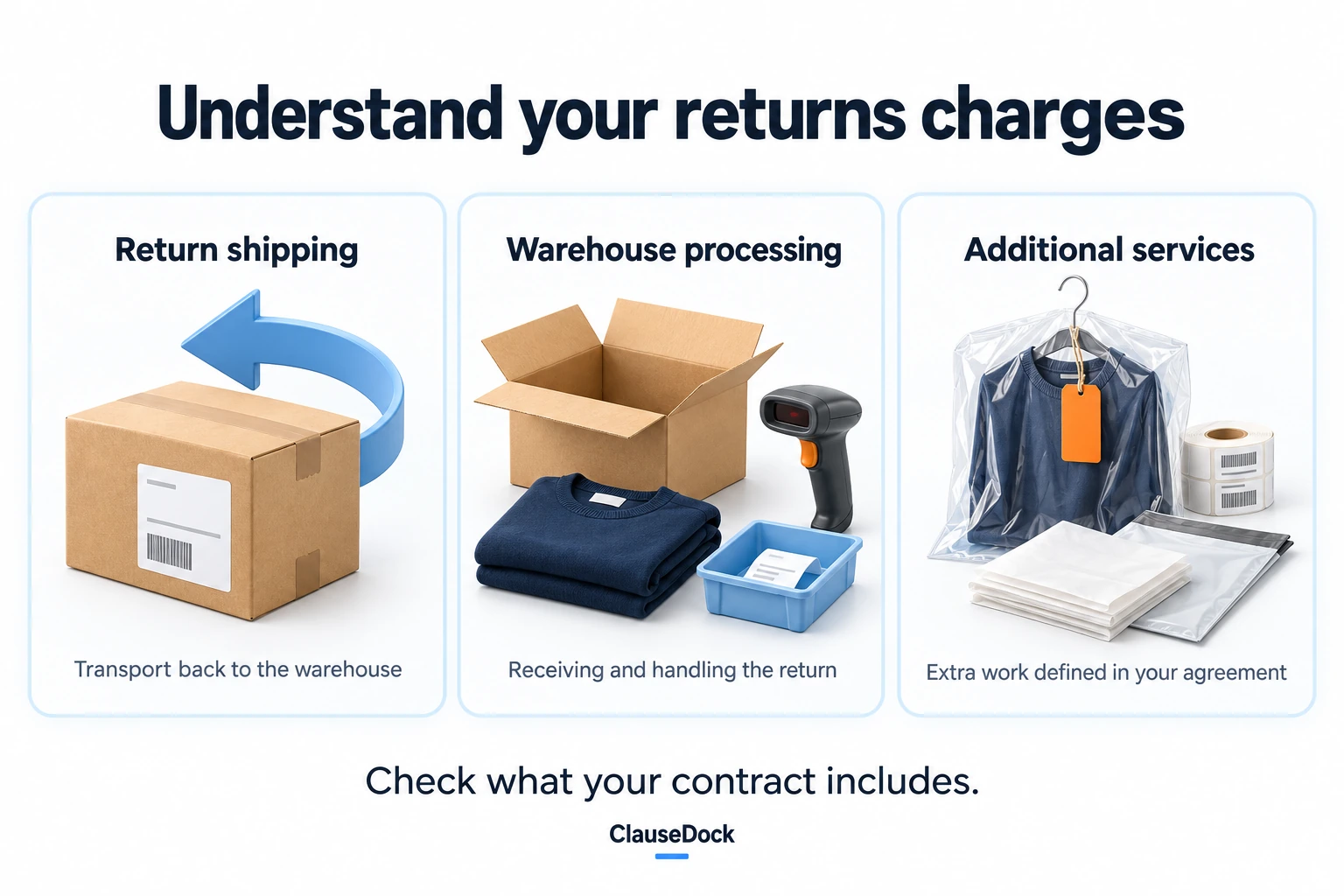
A returned order can create several different charges: a return label, warehouse processing, inspection, repackaging, restocking, or disposal. Those charges may relate to the same product while covering different services.
A useful review connects each line to the governing rate rule, the billable event, and the record showing what happened. The goal is to identify differences another person can reproduce from the same evidence.
1. Identify what the returns fee actually includes
Start with the contract, rate card, and approved returns service instructions that applied during the invoice period. A description such as “return processing” does not establish whether billing applies per carton, return authorization, unit, or labor hour.
Public provider descriptions illustrate the distinction. As reviewed on October 17, 2026, ShipBob's US pricing page describes a flat return fee covering processing of the items in a return, applied when the return physically arrives at its fulfillment center. ShipMonk's pricing page describes returns fees per carton and additional items.
These are examples of billing structures, not rates to apply to your account. Provider descriptions can differ by region and change over time. The documents governing your account determine the applicable rule.
| Question | What to establish |
|---|---|
| What is the billing unit? | Carton, return, item, task, or labor hour |
| What triggers the charge? | Arrival, processing completion, or another defined event |
| What does the base fee include? | Included items and standard handling steps |
| Which services cost extra? | Re-bagging, relabeling, refurbishment, or other work |
| Which rate applies? | Rate effective for the account, location, and period |
| Are there minimums or rounding rules? | How and where they apply |
| When must a billing question be raised? | Applicable notice or dispute deadline |
Do not substitute a public price for a missing account rate.
2. Separate the charge categories
A return label pays for transportation. A processing fee pays for warehouse work. A restocking event records an inventory outcome. Treat them separately unless your agreement expressly bundles them.
| Charge category | Useful supporting evidence |
|---|---|
| Return shipping label | Label purchase, tracking, carrier charge, and any void or refund |
| Base returns processing | Return or carton reference and the defined billing event |
| Additional-item processing | Received units and the included-item allowance |
| Inspection or grading | Task record and applicable inspection rule |
| Repackaging or relabeling | Work record, quantity, and authorization where required |
| Restocking | Inventory movement or putaway record |
| Disposal | Disposition record, quantity, and applicable instructions |
| Hourly returns labor | Labor record, time basis, rate, and minimum or rounding rule |
A processing fee and a label charge on the same return are not automatically duplicates. A separate inspection charge is not automatically wrong either: establish whether the inspection was already included in the base service.
3. Match the invoice to the actual return event
Build a review schedule with one row per billed line. Preserve the original invoice line number and the references used to find supporting records.
Useful fields include:
- Invoice number and line number.
- Return authorization or RMA reference.
- Original order reference and parcel tracking number.
- Warehouse or fulfillment location.
- Arrival and processing dates.
- Cartons received and units received by SKU.
- Service performed and final disposition.
- Rate-card reference.
- Billed amount, expected amount, and difference.
- Evidence status and review note.
One RMA does not always equal one carton. One authorization may arrive in several parcels while the contracted fee applies to each carton separately.
Distinguish expected return quantity from received quantity. A customer may request to return three items but send two. Which quantity is billable depends on the governing rule and the recorded work.
When a reference is missing or matches several possible events, keep the line as Needs review.
4. Check the billing trigger and period
A customer starting a return does not necessarily mean a warehouse processing charge is due. Check whether the contract bases billing on physical arrival, completed processing, a specific rework task, or another defined event.
Then compare that event with the invoice period. A parcel might arrive on September 30 and be processed on October 2. A September charge could be appropriate under an arrival-based rule and require clarification under a completion-based rule.
A timing question is not automatically a duplicate charge. Keep it separate from a claim that the same service was billed twice.
5. Calculate expected 3PL returns processing fees
Use the formula matching the documented billing unit.
Flat fee: Expected processing charge = eligible billable events × applicable rate
Carton fee including one item: Additional-item charge per carton = MAX(0, received items − 1) × additional-item rate
Apply the included allowance at the contractual level. If it applies per carton, calculate each carton separately and then add the results. The aggregate shortcut—total items minus total cartons—only works when every counted carton contains at least one item and the same one-item allowance applies throughout. Otherwise, calculate per carton.
Hourly work: Expected labor charge = billable labor hours × applicable hourly rate
Check whether time represents elapsed time or combined worker time. Apply documented minimums and rounding at the correct task or billing level.
Difference: Candidate difference = billed amount − supported expected amount
A positive difference is a possible overbilling candidate, subject to evidence review. Record negative differences separately too: possible underbilling can affect reconciliation and may lead to a later adjustment. Do not silently net positive and negative lines unless the documented adjustment process supports that treatment.
Worked example
This fictional example illustrates the method. It is not a customer result or evidence of a provider error.
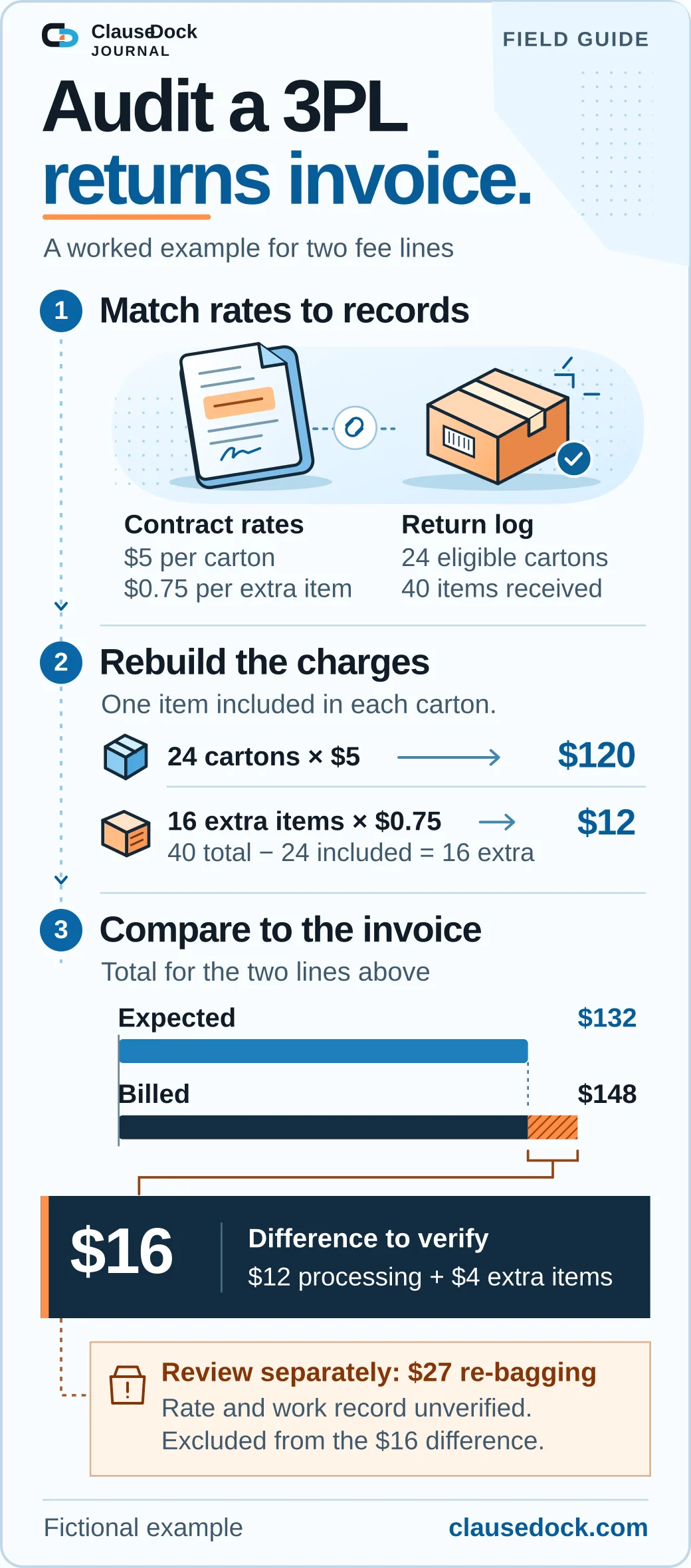
Assume the reviewed documents establish:
- $5.00 per eligible received return carton.
- One item included in each carton.
- $0.75 for each additional item.
- 24 eligible cartons, each containing at least one item.
- 40 items received across those cartons.
- No applicable minimums, exceptions, or previously posted credits.
Additional items = 40 − 24 = 16.
| Invoice charge | Billed | Expected | Candidate difference | Evidence status |
|---|---|---|---|---|
| Processing: 24 cartons at $5.50 | $132.00 | $120.00 | $12.00 | Supported |
| Additional items: 16 at $1.00 | $16.00 | $12.00 | $4.00 | Supported |
| Re-bagging | $27.00 | Not established | Not calculated | Needs review |
| Supported lines only | $148.00 | $132.00 | $16.00 | Supported |
The supported candidate difference is $12.00 + $4.00 = $16.00.
The $27.00 re-bagging line remains a separate question because its rate and work record have not been established. It is excluded from the supported totals. Do not call it an overcharge or assign it an expected amount of zero.
6. Check repeated charges and adjustments
Compare charges across periods using the event reference, service category, quantity, and amount. Flag possible repetitions, but check whether they describe different cartons under one RMA, separate services, later rework, or a reversed charge followed by a corrected replacement.
Also check for a credit against the original amount. Exact repeated CSV rows can be useful leads, but they do not establish whether the underlying service was improperly billed twice. See Duplicate 3PL Charges: How to Find and Verify Them.
Track credits independently from requested corrections. An accepted adjustment is not a posted credit, and a posted credit is not necessarily a cash refund.
7. Send a correction question with traceable evidence
Separate supported differences from unresolved service questions. Identify the invoice line, event, governing rate, calculation, and supporting record. Preserve the applicable notice deadline; a requested response date does not extend it.
Copyable email
Subject: Returns processing review — invoice [number]

Hello [team],

We reviewed the returns charges on invoice [number] for [period].

For lines [references], the applicable rate card [document/version] states [billing rule]. The receiving or processing records [references] show [eligible quantity].

Our calculation is:

- Billed amount: [amount]
- Expected amount under the documented rule: [amount]
- Candidate difference: [amount]

Please confirm the calculation and, if agreed, issue an adjustment referencing the original invoice lines.

Separately, please provide the applicable rate and work record for [additional service]. We have left that charge unresolved and excluded it from the correction amount.

Attached or linked are [relevant records].

Please respond by [date] so we can reconcile before [applicable deadline].

Please let us know if another documented term or event changes the calculation.

Thank you,
[name/team]
For a complete correction workflow, see How to Dispute a 3PL Invoice With Clear Evidence.
8. Use a monthly returns-fee checklist
Frequently asked questions
Is a returns processing fee charged per order or per item?
There is no universal billing unit. Providers may charge per return, carton, item, or another basis. Use the rule governing your account.
Can return shipping and processing both be billed?
Yes, they may cover different services. Check whether transportation is included or separately chargeable under your agreement.
Does restocking prove the processing charge is correct?
No. It can support what happened to inventory, but you still need the applicable billing rule and quantity.
Should a fee without supporting records be treated as an overcharge?
No. Mark it Needs review, request the missing evidence, and exclude it from the supported correction total.
Do damaged items count as processed returns?
They may. Processing can be billable even when an item cannot be restocked. Check the contracted trigger and service performed, as explained in section 4.
Make returns charges easier to review
A useful review of 3PL returns processing fees connects each charge to a defined service, a documented rate, and a traceable event.
Start with the complete 3PL invoice audit guide. Use the free ClauseDock review workbook to organize references, evidence status, and review notes. Calculate returns fees in a separate schedule matching your contract.
The strongest correction request is one another person can reproduce from the same documents.