
CLAUSEDOCK GUIDES
How to Calculate 3PL Storage Fees and Check Your Invoice

A warehouse storage invoice can use the correct rate and still charge the wrong amount. The difference may come from the number of locations counted, the dates included, the dimensions used, or a minimum charge applied incorrectly.
To calculate 3PL storage fees, identify the contract’s billing unit and measurement method first. Then reconstruct the eligible quantity for the billed period, apply the effective rate, and account for documented minimums, adjustments, and credits.
Multiplying the invoice quantity by its displayed rate checks the invoice’s arithmetic. It does not establish whether that quantity or rate belongs on the bill.
This guide explains how to review pallet, bin, shelf, and cubic-foot storage charges, with worked calculations and a checklist you can reuse.
If your working file combines several billing exports, ClauseDock’s free CSV checker can help identify complete repeated rows before you total them. It runs locally in your browser. Contractual storage calculations still require the applicable terms and occupancy records.
Storage Fee Formulas at a Glance
Use the formula that matches your agreement. These methods are alternatives, not interchangeable ways to calculate the same invoice.
| Billing Method | Formula | Record You Need |
|---|---|---|
| Specified snapshot of pallet positions | Eligible positions at the snapshot × monthly rate | Location report at the exact measurement time |
| Daily prorated locations | Location-days × monthly rate ÷ contract-defined day denominator | Daily occupancy history |
| Average volume | Average eligible cubic feet × monthly rate per cubic foot | Daily quantities and applicable dimensions |
| Minimum operating as a floor | Greater of eligible base storage or applicable minimum | Exact minimum clause and covered charges |
For dimensions measured in inches:
Cubic feet = length × width × height ÷ 1,728
A calendar-month denominator is used in the daily-prorating example below. Your agreement may define another convention.
All numerical examples in this guide are fictional. Their rates illustrate calculations; they are not market benchmarks, provider quotes, or customer results.
1. Identify What Your 3PL Storage Fees Are Based On
Warehouse storage fees may be quoted per month, but “monthly storage” describes a period. It does not fully define the charge.
Your agreement might charge for an occupied pallet position, a dedicated bin, an allocated shelf, a measured volume, or reserved floor space. The charge might depend on a daily average, a particular snapshot, or a minimum commitment.
Start by recording these details:
| Contract Detail | What to Establish |
|---|---|
| Billing unit | Pallet position, bin, shelf, cubic foot, square foot, or another defined unit |
| Measurement method | Daily occupancy, average volume, specified snapshot, peak quantity, or reserved capacity |
| Applicable rate | Rate for the facility, storage type, and effective dates |
| Time rule | Daily rate, monthly rate, calendar-month prorating, or another written convention |
| Location definition | Whether billing applies per SKU, physical location, allocated space, or another basis |
| Additional terms | Minimums, rounding, seasonal rates, aged-inventory charges, or special handling |
| Credits | Adjustments already issued for the same fee and period |
These rules must come from the documents that govern your account.
ShipBob, for example, describes bin, shelf, and pallet locations, with cubic-foot pricing for brands with high SKU counts. Its explanation states that each SKU uses its own location and that storage is billed twice monthly, prorated to the day.
Amazon’s FBA overview describes monthly storage charges based on daily average volume in cubic feet. That is an Amazon-specific example of a measurement method, not a rule to apply to another warehouse.
Fulfillment.com’s pricing explanation describes storage rates contracted for each client based on volume and SKU profile.
Use public explanations to understand possible models. Use your signed terms and effective amendments to calculate your own bill.
2. Match the Billing Method to the Right Records
The evidence you need depends on how the fee is measured.
A month-end inventory report cannot, on its own, reproduce a charge based on daily occupancy. A count of sellable units cannot establish the number of dedicated pallet positions.
| Billing Method | Useful Supporting Records | Common Comparison Mistake |
|---|---|---|
| Specified monthly snapshot | Location or inventory report at the exact measurement time | Using a report from a different date |
| Daily occupied locations | Daily occupancy history or complete location opening and closing records | Using only the final day’s count |
| Average cubic volume | Daily quantities and the applicable measured dimensions | Multiplying ending stock by a monthly rate |
| Reserved floor space | Contracted area, allocation records, and effective dates | Assuming empty reserved space is automatically free |
| Minimum charge | Eligible base charges and the exact minimum clause | Adding the full minimum on top of base storage |
Ask for a storage billing breakdown when the invoice shows only a total.
Useful fields include facility, storage type, location or SKU reference, billed dates, quantity, unit, rate, amount, and adjustment references.
Preserve the original export. If you normalize labels or combine reports, keep those changes in a separate working file.
3. Example: Calculate Full-Month Pallet Storage Costs
Pallet storage costs are straightforward to reconstruct when the agreement defines a specific snapshot and the matching location report is complete.
Assume an agreement charges $24 per billable pallet position per month.
For this example, the contract defines the quantity using a specified monthly snapshot. The complete matching report supports 120 billable positions.
The expected base charge is:
120 positions × $24 = $2,880
The invoice instead lists 126 positions:
126 × $24 = $3,024
| Item | Calculation | Amount |
|---|---|---|
| Billed storage | 126 × $24 | $3,024 |
| Reconstructed storage | 120 × $24 | $2,880 |
| Difference to investigate | 6 × $24 | $144 |
Before requesting a correction, confirm that:
- Both counts cover the same facility.
- The source uses the snapshot required by the agreement.
- The 120 positions include all eligible storage categories.
- The invoice does not include separately allocated locations omitted from the report.
- No amendment changed the rate or quantity definition.
- The same difference has not already been credited.
The arithmetic establishes a $144 candidate difference. Complete, matching records and the governing terms determine whether that difference is supported.
A Partly Filled Pallet May Still Occupy a Billable Position
Do not reduce a position-based charge merely because a pallet is half full.
If the agreement bills occupied positions, one partly filled pallet may still use one position. If it bills measured volume, the calculation will be different.
Physical utilization and billing accuracy are related questions, but they require different evidence.
4. Example: Calculate Prorated Storage Fees Using Location-Days
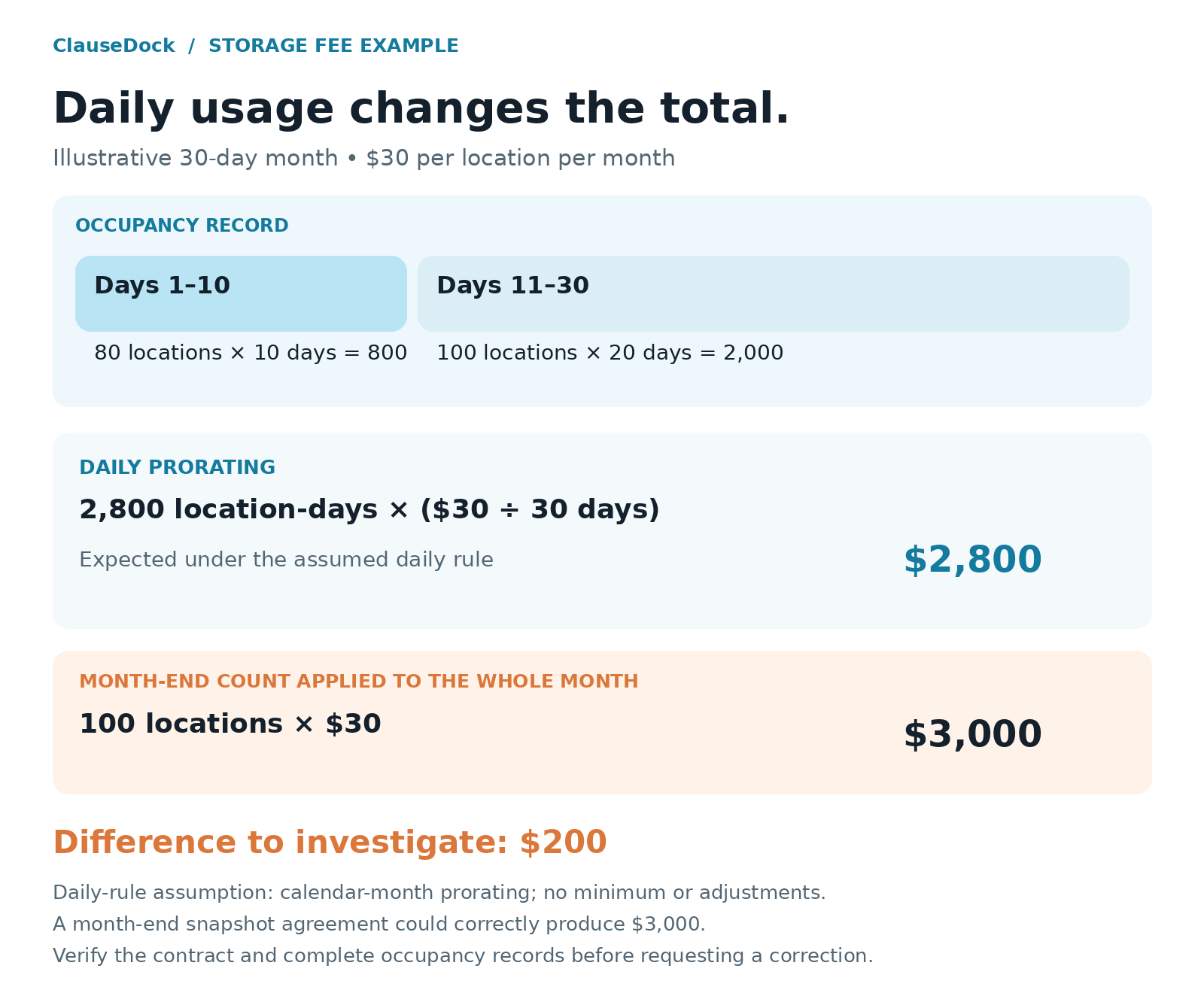
Daily prorating requires the number of billable locations on each eligible day. The same location-day method can apply to bins, shelves, or pallet positions when their governing terms use daily occupancy.
Assume this agreement specifies:
- $30 per occupied location per calendar month.
- A 30-day billing month.
- A daily charge of the monthly rate divided by the number of days in that month.
- No minimum or other adjustment in this example.
The daily rate is:
$30 ÷ 30 days = $1 per location-day
The complete occupancy report shows:
| Period | Days | Occupied Locations | Location-Days |
|---|---|---|---|
| Days 1–10 | 10 | 80 | 800 |
| Days 11–30 | 20 | 100 | 2,000 |
| Total | 30 | — | 2,800 |
The expected charge is:
2,800 location-days × $1 = $2,800
Charging the ending count for the entire month would produce:
100 locations × $30 = $3,000
That creates a $200 difference under the assumed daily-prorating rule.
However, $3,000 could be correct under a different agreement that explicitly uses a month-end snapshot. Follow the actual contract.
Calculate the Example in a Spreadsheet
Enter the following values:
| Cell | Meaning | Value |
|---|---|---|
| B2 | Days in the first interval | 10 |
| C2 | Occupied locations during that interval | 80 |
| B3 | Days in the second interval | 20 |
| C3 | Occupied locations during that interval | 100 |
| B5 | Monthly rate per location | 30 |
| B6 | Calendar days in the billing month | 30 |
Calculate total location-days with:
=SUMPRODUCT(B2:B3,C2:C3)Calculate the storage charge with:
=SUMPRODUCT(B2:B3,C2:C3)*B5/B6The example produces 2,800 location-days and a $2,800 charge.
Extend both ranges together for additional intervals. Use numeric inputs and non-overlapping intervals that cover every billable day. If the applicable rate changes, split the calculation by rate rather than applying one monthly rate to all intervals.
Some spreadsheet settings use semicolons instead of commas between function arguments.
An Equivalent Calculation Using Average Occupancy
The average occupied location count is:
2,800 location-days ÷ 30 days = 93.333… locations
Then:
93.333… × $30 = $2,800
Keep full precision until the documented rounding stage. Rounding the average to 93 before multiplying would produce $2,790 and introduce a new error.
Do Not Assume Every Month Has 30 Days
Under calendar-month prorating, February and a 31-day month have different denominators.
Some agreements use a fixed convention instead. Others state a daily rate directly.
For a half-month invoice, establish whether the denominator remains the full calendar month. Dividing a monthly rate by 15 simply because the invoice covers 15 days can double the effective daily charge.
5. Example: Calculate Cubic-Foot Storage
A cubic foot storage calculation needs both the dimensions and the quantity defined by the agreement.
When dimensions are measured in inches:
Cubic feet = length × width × height ÷ 1,728
When dimensions are measured in centimeters:
Cubic meters = length × width × height ÷ 1,000,000
One cubic meter is approximately 35.3147 cubic feet. Keep sufficient precision through the calculation and apply the agreement’s rounding rule at the required stage.
Assume a storage agreement bills the average external volume of eligible stored cartons at $0.60 per cubic foot per month.
Each carton measures:
- Length: 24 inches.
- Width: 18 inches.
- Height: 12 inches.
The volume of one carton is:
24 × 18 × 12 ÷ 1,728 = 3 cubic feet
If the verified daily average is 60 cartons, the average volume is:
60 × 3 = 180 cubic feet
The expected monthly base charge is:
180 × $0.60 = $108
| Input | Value |
|---|---|
| Volume per carton | 3 cubic feet |
| Daily average eligible cartons | 60 |
| Average eligible volume | 180 cubic feet |
| Monthly rate | $0.60 per cubic foot |
| Expected base charge | $108 |
This example assumes constant carton dimensions and no minimum, surcharge, or rounding adjustment.
For several SKUs or package sizes, calculate each applicable volume separately and sum the results.
Establish Which Dimensions Are Billable
A product’s retail dimensions may differ from its packaged dimensions, carton dimensions, or allocated storage footprint.
Check whether the agreement measures:
- Individual packaged units.
- Outer cartons.
- Pallets, including a defined height.
- Allocated warehouse capacity.
- Another specified volume.
Do not count the same inventory once as individual units and again as cartons unless the agreement explicitly requires separate charges.
When billed dimensions differ from your records, ask which measurement was used, when it was taken, and how it affects the fee. A different measurement is a review question until the governing basis is established.
6. Check Minimum Charges Before Labeling a Difference
A minimum can make a storage charge higher than the simple quantity-times-rate result.
Assume eligible base storage calculates to $240, and the agreement requires a $300 monthly storage minimum.
If that minimum operates as a floor, the calculation is:
Expected storage = greater of $240 or $300 = $300
One invoice might show a single $300 line. Another might show:
| Line | Amount |
|---|---|
| Base storage | $240 |
| Minimum adjustment | $60 |
| Total | $300 |
Adding a full $300 minimum to the $240 base would produce $540. That does not match the assumed floor rule.
However, an agreement could instead contain a separate capacity reservation fee. Read the clause before treating every charge labeled “minimum” as the same mechanism.
Also establish whether the minimum applies:
- Across the entire account.
- Separately to each facility.
- To storage alone.
- To a defined group of services.
- Before or after discounts and credits.
A storage correction can also affect a minimum adjustment. Recalculate both when the clause links them.
7. Investigate Differences That Simple Multiplication Misses
Several issues can change the eligible quantity without changing the displayed rate.
Incorrect Start or End Dates
Receiving, putaway, allocation, shipment, and location closure can happen at different times.
Identify which event starts or ends billing. Do not assume the carrier delivery timestamp or order shipment date is automatically the storage billing boundary.
To distinguish inbound processing quantities and dates from storage billing, see 3PL Receiving Fees: How to Check Your Invoice.
Location Changes
Inventory can move from bins to shelves or pallets during the month.
A proper reconciliation should establish the billable dates and rates for each location type. An apparent overlap may require review, but both locations could have been legitimately occupied during a transition.
Transfers Between Facilities
Destination receipt and origin departure may occur on different dates. Transit time, reserved capacity, and processing rules can affect the result.
A transfer alone does not prove that storage at two facilities was duplicated.
Returns, Quarantine, or Damaged Stock
Non-sellable inventory may still occupy chargeable space.
A sellable-inventory report can understate billable storage if the agreement includes other inventory statuses.
Overlapping Exports
A monthly report and two half-month reports may describe the same activity. Combining all three can create duplicates in your working file.
Check report coverage before summing charges. See how to find and verify duplicate 3PL charges.
If you have merged several exports, open the free CSV checker to look for complete repeated rows. It runs in your browser without uploading the file.
Its results identify rows to review. Legitimate records can repeat, and overlapping activity with different row contents will not necessarily be detected.
Rate Changes Within a Period
If an amendment takes effect mid-month, separate the affected dates and eligible quantities. Applying the new rate to the whole month may not match the agreement.
Additional Storage-Related Charges
Aged inventory, special conditions, or other charges need their own documented eligibility rules.
A high total does not establish an error. Trace each fee to its clause, dates, and supporting quantity.
8. Build a Reconciliation Another Reviewer Can Reproduce
A 3PL storage cost calculation is useful only when another reviewer can reproduce its inputs, method, and result.
Use one row per invoice line, splitting calculations into detail rows when dates, rates, or storage types change.
| Field | What to Record |
|---|---|
| Invoice reference | Invoice number and original line reference |
| Scope | Account, facility, currency, and billing period |
| Billed inputs | Storage type, unit, quantity, rate, and amount |
| Governing source | Clause, amendment, effective date, and page reference |
| Operational source | Filename, tab or report, dates, and relevant records |
| Expected inputs | Eligible quantity, rate, time convention, and adjustments |
| Calculation | Formula and rounding method |
| Difference | Billed amount minus reconstructed expected amount |
| Evidence status | Supported discrepancy, Needs review, or Resolved |
| Outcome | Explanation, accepted adjustment, credit reference, and posting date |
Keep taxes and unrelated fees separate unless they belong in the comparison. If correcting storage affects tax, identify that as a separate dependent calculation.
Use Needs review when the records are incomplete or the clause is unclear. Do not fill missing days with an assumption and present the result as verified.
For the wider review process, see how to audit a 3PL invoice.
9. Request a Specific Explanation or Correction
For the full template, evidence packet, and credit follow-up, see how to dispute a 3PL invoice.
A useful request identifies one line, explains the governing method, shows the calculation, and states what you need the provider to confirm.
For the pallet example:
Subject: Storage quantity review — [invoice reference]

Hello [provider team],

Please review storage line [line reference] for [billing period] at [facility].

The invoice lists 126 pallet positions at $24, totaling $3,024. Clause [reference], effective [date], defines the charge using [specified measurement method].

The matching report [filename and report reference] supports 120 eligible positions. On that basis, the reconstructed amount is $2,880, a difference of $144.

Please confirm which additional six positions were included and provide the supporting breakdown. If the calculation reflects the applicable terms and complete activity, please issue the corresponding correction.

Please also identify any adjustment already issued for this line.

Thank you,
[name / team]
Share supporting records through your provider’s approved channel and follow the notice requirements in your agreement.
Track the response and any correction through to the account ledger. A requested adjustment, an accepted adjustment, a posted credit, and a cash refund are different outcomes.
Storage Invoice Review Checklist
Before closing the review, confirm that:
Frequently Asked Questions
How Are 3PL Storage Fees Calculated?
Identify the contractual unit and measurement method, reconstruct the eligible quantity for the period, and apply the effective rate. Then apply documented minimums, adjustments, and credits.
There is no single formula that covers every storage agreement.
Is Pallet Storage Charged by Pallet or Pallet Position?
Either may appear in an agreement. Establish whether the unit means a physical pallet, an occupied position, reserved capacity, or another defined measure.
The invoice label alone may not answer that question.
Can I Use Month-End Inventory to Check Daily Storage Fees?
A single snapshot does not establish daily occupancy. Use a complete daily history or records sufficient to reconstruct every billable day.
Month-end inventory is appropriate when it matches the contract’s specified snapshot method.
Is Storage for an Empty Location Always Incorrect?
No. A location may remain chargeable under a reservation, allocation, or minimum commitment.
If the agreement charges only occupied days, verify the documented closure date and any rule about when occupancy ends.
Can ClauseDock’s Free CSV Checker Help With a Storage Review?
It can help identify complete repeated rows after basic text normalization when you combine billing exports. It runs in your browser without uploading the file.
Review the flagged rows against their source reports before removing anything.
The checker does not interpret storage clauses, reconstruct occupancy, verify dimensions, or calculate a contractual storage charge.
Discuss a Review of Your 3PL Storage Fees
Tell us which storage method your agreement uses and which records you have. Ask whether those records and the fee type fit the scope that can be reviewed.
ClauseDock does not currently review storage invoices. The self-service product is in development and its first release will support only flat per-reference Handling fees.
File submission and payments are not open today. Availability, supported scope, price, and a secure document process must be confirmed before any order.
Sources and Further Reading
- ShipBob: How ShipBob Optimizes Storage Costs for Fast-Moving Inventory — provider-specific explanation of storage locations, billing frequency, and daily prorating.
- Amazon: Fulfillment by Amazon — provider-specific example of storage measured using daily average volume.
- Fulfillment.com: Fulfillment Cost — explanation of storage rates contracted for each client.
These sources describe their respective services. Your governing agreement and effective rate documents determine your bill.
Guides in This Series
- How to Audit a 3PL Invoice: A Practical Checklist
- Duplicate 3PL Charges: How to Find and Verify Them
- How to Calculate 3PL Storage Fees and Check Your Invoice
- How to Dispute a 3PL Invoice With Clear Evidence
- 3PL Fulfillment Fees: How to Check Your Invoice
- 3PL Receiving Fees: How to Check Your Invoice