
CLAUSEDOCK GUIDES
3PL Receiving Fees: How to Check Your Invoice

Checking 3PL receiving fees means matching an inbound charge to the agreed billing unit, the applicable rate, and the records of work performed.
Your supplier may ship 120 cartons, but the warehouse may receive only 96 during the invoice period. A delivery may arrive on 12 pallets and later occupy 14 storage locations. Two people unloading a shipment for 75 minutes perform more labor than one person working for the same elapsed time.
Each distinction can change the expected charge.
A reliable receiving-fee review answers four questions:
- What receiving event triggered the charge?
- What unit does the agreement bill?
- What quantity or labor time supports that unit?
- Which allowances, minimums, and exceptions apply?
This guide explains how to check carton and pallet quantities, labor charges, included time, rounding rules, and additional receiving services. It also shows how to keep a supported discrepancy separate from a question that still needs evidence.
All worked examples, rates, references, and amounts below are fictional. They illustrate review methods, not market prices, customer results, or verified provider errors.
What Are 3PL Receiving Fees?
3PL receiving fees are charges for processing inventory arriving at a third-party logistics warehouse.
Depending on the agreement, receiving may cover unloading, checking quantities, scanning products, recording discrepancies, or moving goods into their initial storage locations.
Providers can price this work differently. Your schedule may use a fee per carton, pallet, container, unit, inbound shipment, or labor hour. It may also combine a base fee with an included allowance and additional charges.
Receiving is a separate stage from ongoing storage and outbound order fulfillment, although an agreement may bundle some services.
ShipBob’s pricing page lists receiving inventory among its standard fee categories. That public description helps identify the service category; your account agreement establishes the applicable rate and inclusions.
This guide focuses on checking an existing invoice. It does not establish what a provider should charge or provide a market-price benchmark.
The Review Process at a Glance
- Define which receiving services you are reviewing.
- Establish the billable unit and triggering event.
- Gather the records needed to reproduce the charge.
- Reconcile expected, delivered, and processed quantities.
- Recalculate quantity-based fees.
- Recalculate labor: person-hours, allowances, rounding, and minimums.
- Review additional work under its own rule.
- Build a reconciliation and total only supported differences.
- Request a specific explanation or correction.
- Check the next invoice and improve the inbound process.
1. Define Which Receiving Services You Are Reviewing
Begin with the invoice lines, then identify the work each line represents.
A shipment may generate several charges without those charges necessarily describing the same service.
| Possible Charge | What to Establish |
|---|---|
| Standard receiving | Which inbound processing tasks are included? |
| Unloading | Is unloading included or separately billable? For a floor-loaded container, is palletizing included? |
| Product counting | Does the base fee include the stated counting method? |
| Labeling or relabeling | What work was required and performed? |
| Pallet breakdown | Does it involve work beyond standard receiving? |
| Special inspection | What scope and pricing rule apply? |
| Storage | When does storage billing begin, and what unit applies? |
| Carrier detention | Who billed the waiting time, and under which terms? |
These are possible categories, not a universal fee schedule.
Keep carrier transportation and detention separate from warehouse processing unless the agreement expressly combines them.
Likewise, receiving a pallet and storing a pallet are different events. Their quantities may differ without either charge being incorrect.
For ongoing inventory charges, see How to Calculate 3PL Storage Fees and Check Your Invoice.
For outbound work, use 3PL Fulfillment Fees: How to Check Your Invoice.
2. Establish the Billable Unit and Triggering Event
The rate is useful only when it is applied to the unit defined by the agreement.
| Pricing Structure | Quantity to Verify | Rule to Confirm |
|---|---|---|
| Per carton | Eligible cartons processed | What counts as one billable carton? |
| Per pallet | Eligible pallets received or processed | Is the fee based on inbound pallets or another defined event? |
| Per container | Eligible containers unloaded | Does the fee cover unloading and palletizing, and does container size change the rate? |
| Per unit | Eligible product units | Are cases, kits, and individual units treated differently? |
| Per inbound shipment | Eligible receiving events | Can split deliveries trigger more than one fee? |
| Per labor hour | Supported person-hours | Which tasks and time entries qualify? |
| Base fee plus additional labor | Base event and excess eligible time | Where does the included allowance apply? |
Record the warehouse, service, rate version, effective date, currency, and tax treatment.
A purchase order is not necessarily one delivery. One receiving reference may contain multiple boxes, arrivals, or processing stages.
In its receiving documentation, ShipBob uses a Warehouse Receiving Order, or WRO, to manage inbound shipments. The documentation distinguishes packages, pallets, and floor-loaded containers and describes tracking references for boxes or pallets.
Those records can help connect activity to a charge. They do not, by themselves, establish the contractual billing rule.
If “per shipment” is ambiguous, ask whether it means a purchase order, receiving reference, delivery appointment, vehicle arrival, or another event.
Keep the fee as Needs review until that definition is established.
3. Gather the Records Needed to Reproduce the Charge
Preserve the invoice and original exports before making changes.
Useful evidence may include:
| Record | What It Helps Verify |
|---|---|
| Invoice detail | Billed service, quantity, rate, amount, and reference |
| Agreement and amendments | Applicable pricing and inclusions |
| Purchase order | What was ordered |
| Packing list | What the supplier declared as shipped |
| ASN or receiving reference | Expected inbound shipment structure |
| Delivery record | Arrival, shipment reference, and recorded quantities |
| Warehouse receipt | Quantities processed and receiving status |
| Discrepancy record | Shortages, damage, overages, or other exceptions |
| Labor record | Workers, tasks, duration, and reference |
| Work order | Scope and approval of separately billed work |
No single record necessarily answers every question.
A packing list describes the supplier’s shipment declaration. A warehouse receipt records the receiving activity available in that system. If they differ, investigate the reason and the agreement’s quantity basis.
Save the export filters, including warehouse, date field, status, and service category.
Preserve identifiers as text. Leading zeros and long references can be damaged by spreadsheet conversion.
Keep the Important Dates Separate
An inbound shipment can have several relevant dates:
- Expected arrival.
- Actual delivery.
- Receiving start.
- Receiving completion.
- Initial putaway.
- Invoice posting.
Use the date that triggers billing under the agreement.
For example, an arrival on September 30 and completion on October 2 may belong to different billing periods depending on the agreed rule.
Verify the time zone for records near a period boundary.
4. Reconcile Expected, Delivered, and Processed Quantities
Avoid treating every quantity field as interchangeable.
Consider a shipment with 120 cartons on its packing list:
| Quantity Stage | Cartons |
|---|---|
| Supplier packing list | 120 |
| Recorded delivery during the reviewed period | 96 |
| Matching completed warehouse receipt | 96 |
| Remaining cartons | Not established by the available records |
ShipBob’s receiving documentation, for example, distinguishes expected, received, and stowed item quantities. These describe what was declared, what arrived, and what was added to available inventory. They can differ, so the quantity your agreement bills must be identified.
Item-unit fields also need to be distinguished from carton and pallet counts.
The missing 24 cartons might be delayed, delivered separately, incorrectly recorded, or absent from the export.
The next step is to identify which quantity the agreement bills and whether the records cover the complete event.
If standard receiving is billed per completed carton, the completed receipt is relevant. If another documented rule applies, use that rule instead.
Watch for Repeated Records
The same receipt may appear in overlapping exports or in several status updates.
Repeated rows in your review file do not necessarily represent repeated invoice charges.
ClauseDock’s free CSV checker can flag repeated complete rows after normalizing whitespace and letter case. It runs in your browser without uploading the file.
Use it to investigate possible export overlap. It does not decide which status record is authoritative or calculate receiving fees.
For a deeper review of repeated charges, see Duplicate 3PL Charges: How to Find and Verify Them.
5. Recalculate Quantity-Based Fees
Start with a charge whose service, quantity, and rate you can establish.
Keep calculations separate when warehouses, rate versions, or service definitions differ.
Example A: Cartons Shipped Versus Cartons Processed
Assume the agreement states:
- Standard receiving costs $1.25 per completed carton.
- The fee covers the standard receiving tasks in this example.
- No minimum or additional fee applies.
- Complete matching records establish 96 completed cartons.
The invoice bills 120 cartons:
| Item | Calculation | Amount |
|---|---|---|
| Billed receiving | 120 × $1.25 | $150.00 |
| Expected receiving | 96 × $1.25 | $120.00 |
| Potential adjustment | 24 × $1.25 | $30.00 |
The supported difference is:
$150.00 billed − $120.00 expected = $30.00
This conclusion depends on the completed-carton rule and complete matching activity.
If the warehouse records are still incomplete, the same arithmetic produces a question to investigate, not a supported discrepancy.
Example B: Inbound Pallets Versus Storage Locations
Assume the agreement charges $8.00 per inbound pallet received.
The complete inbound record establishes 12 pallets. The warehouse later places the goods into 14 storage locations.
The invoice bills 14 receiving pallets:
| Item | Calculation | Amount |
|---|---|---|
| Billed receiving | 14 × $8.00 | $112.00 |
| Expected receiving | 12 × $8.00 | $96.00 |
| Potential adjustment | 2 × $8.00 | $16.00 |
$112.00 − $96.00 = $16.00
The storage-location count does not establish the receiving quantity under this stated rule.
However, if the agreement separately prices pallet rebuilding or another handling event, review that service under its own definition and evidence.
Spreadsheet Formula for a Simple Quantity-Based Fee
Use one row per distinct billable receiving event and service:
- Column A: receiving reference.
- Column B: verified billable quantity.
- Column C: applicable rate.
- Column D: expected amount.
In D2:
=ROUND(B2*C2,2)This formula assumes the agreement rounds each line to two decimal places.
If the provider rounds after aggregation, uses a different currency precision, or applies minimums, adapt the calculation to that rule.
Apply an event-level base fee once per receiving event, rather than once per SKU row.
6. Recalculate Labor: Person-Hours, Allowances, Rounding, and Minimums
Elapsed time measures how long an activity took.
Person-hours measure the labor contributed by the people performing it.
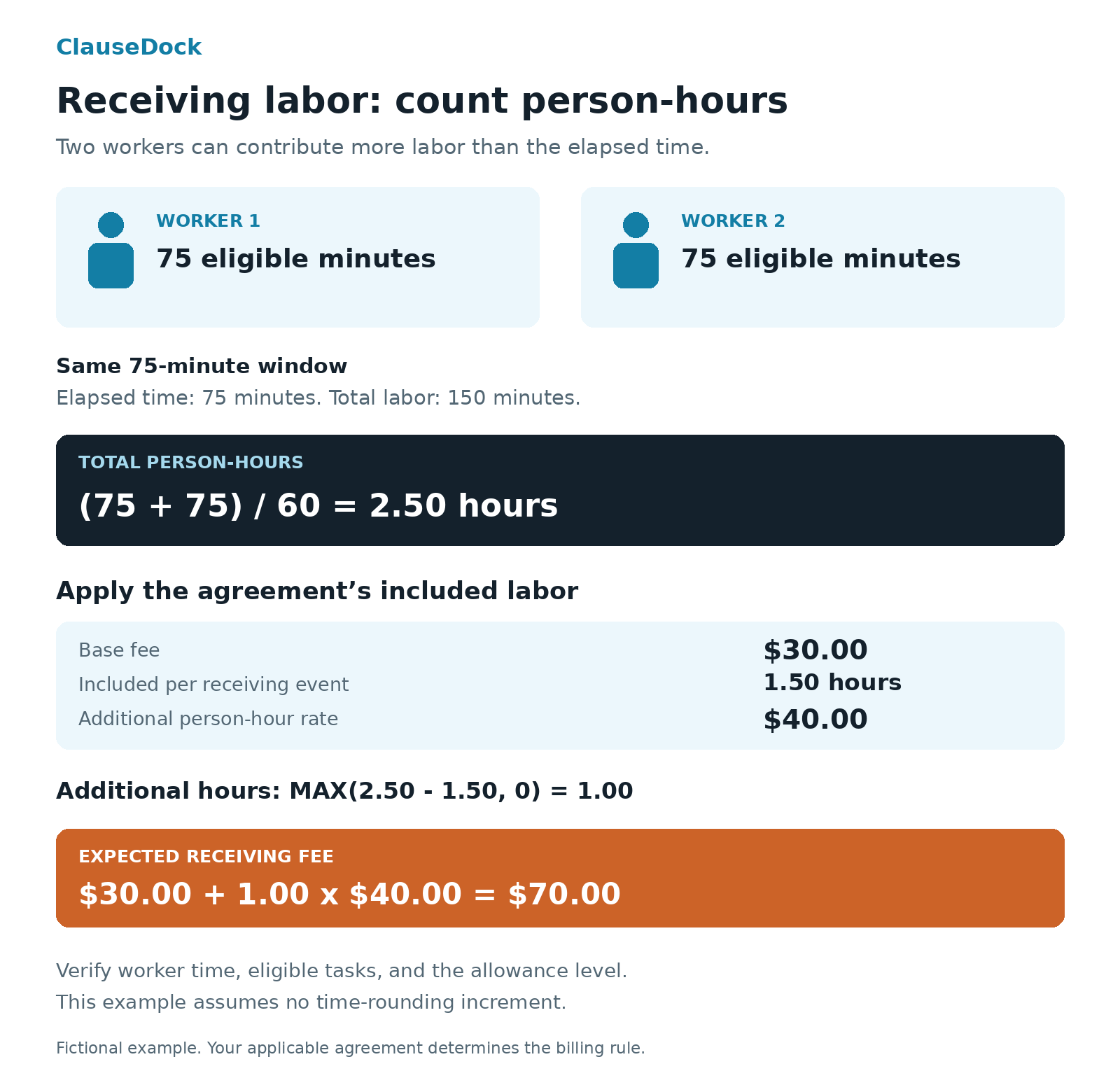
If two workers each spend 75 minutes on eligible receiving tasks:
Total person-hours = (75 + 75) ÷ 60 = 2.50 hours
The elapsed duration may be 75 minutes, but the labor contribution is 150 minutes.
This difference matters when the agreement bills per worker-hour.
Example C: Base Fee With Included Labor
Assume the agreement states:
- Base fee: $30.00 per receiving event.
- Included labor: 1.50 person-hours per event.
- Additional labor: $40.00 per person-hour.
- No rounding increment applies.
- Two workers each record 75 eligible minutes.
| Item | Calculation | Result |
|---|---|---|
| Total labor | 150 minutes ÷ 60 | 2.50 hours |
| Included labor | Per-event allowance | 1.50 hours |
| Additional labor | MAX(2.50 − 1.50, 0) | 1.00 hour |
| Expected fee | $30.00 + 1.00 × $40.00 | $70.00 |
Suppose the invoice bills the base fee plus 1.50 additional hours:
$30.00 + 1.50 × $40.00 = $90.00
The potential adjustment is:
$90.00 − $70.00 = $20.00
This difference is supported only if the complete labor records and allowance rule are established.
Spreadsheet Formula for the Stated Labor Rule
Assume:
- B2 contains verified total person-hours.
- C2 contains included person-hours.
- D2 contains the base fee.
- E2 contains the additional hourly rate.
The expected fee is:
=ROUND(D2+MAX(B2-C2,0)*E2,2)Use one row per receiving event when the allowance applies per event.
For time recorded in minutes, convert the verified total to hours by dividing by 60. For spreadsheet time values, verify their representation before converting; a displayed duration is not necessarily stored as a decimal number of hours.
Apply Rounding at the Defined Level
Assume two workers each record 70 minutes and the agreement rounds each worker’s eligible time upward to the next 15-minute increment.
Each worker’s time becomes 75 minutes:
75 + 75 = 150 minutes = 2.50 person-hours
If the agreement instead sums actual minutes first and then rounds the event total upward to 15 minutes:
70 + 70 = 140 minutes → 150 minutes
Those two methods happen to agree in this example.
They do not always agree.
With two workers each recording 61 minutes:
| Rounding Method | Billable Minutes |
|---|---|
| Round each worker upward to 15 minutes, then sum | 75 + 75 = 150 |
| Sum first, then round the event total upward to 15 minutes | 122 → 135 |
| Difference | 15 |
At $40.00 per hour, the difference is:
15 ÷ 60 × $40.00 = $10.00
That is a difference between interpretations. It becomes a supported billing discrepancy only after the agreement establishes which method applies.
Also verify whether rounding occurs before or after subtracting the included allowance.
Spreadsheet Formulas for the Rounding Comparison
With the two workers’ eligible minutes entered as nonnegative numbers in B2 and C2, round each worker upward to 15 minutes, then sum:
=CEILING(B2,15)+CEILING(C2,15)To sum the minutes first and then round the event total upward to 15 minutes:
=CEILING(B2+C2,15)For 61 and 61 minutes, these return 150 and 135 minutes respectively.
For 70 and 70 minutes, both return 150 minutes.
These results are minutes, not hours or dollars. Divide by 60 before applying an hourly rate.
The formulas demonstrate the two rounding methods. Apply an included allowance in the order specified by the agreement.
If your spreadsheet uses semicolons as argument separators, replace the commas accordingly.
Check a Minimum Receiving Charge as a Floor
Assume a separate receiving rule sets:
- Standard receiving: $1.25 per completed carton.
- Minimum charge: $25.00 per receiving event.
- The minimum is a floor, rather than an additional service fee.
A 15-carton receipt calculates to:
15 × $1.25 = $18.75
The expected charge is:
MAX($18.75, $25.00) = $25.00
The top-up needed to reach the floor is:
$25.00 − $18.75 = $6.25
Billing $18.75 plus a separate $25.00 minimum would produce $43.75, which does not match this floor rule.
Confirm whether the minimum is a floor or an additive fee, and which services count toward it.
This is an independent illustration. It is outside the supported discrepancy total below.
7. Review Additional Work Under Its Own Rule
Receiving exceptions can involve legitimate additional work. Establish the trigger, scope, rate, and activity.
Examples include missing labels, mixed cartons requiring sorting, extra counting, relabeling, or separately requested inspection.
For each charge, ask:
- What condition triggered the work?
- Which agreement term permits the charge?
- What tasks were performed?
- What quantity or time supports the amount?
- Was approval required, and is it documented?
- Is the same work already included in standard receiving?
ShipMonk’s pricing page describes special projects as work beyond regular fulfillment and explains its project-scoping and quoting process. This is a provider-specific example; verify your own agreement.
Example D: A Relabeling Charge With Missing Support
Suppose the invoice contains:
200 units × $0.20 = $40.00
Available records show a labeling issue but do not establish how many units were relabeled or whether standard receiving includes the work.
Record:
- Billed amount: $40.00.
- Expected amount: not yet established.
- Potential adjustment: not yet established.
- Evidence status: Needs review.
Request the work record and applicable pricing term.
Missing support justifies a request for clarification. It does not automatically establish a $40.00 overcharge.
8. Build a Reconciliation and Total Only Supported Differences
Keep independent examples separate, then total only supported differences.
Under the established assumptions in Examples A, B, and C:
| Issue | Billed | Expected | Potential Adjustment | Evidence Status |
|---|---|---|---|---|
| Completed cartons | $150.00 | $120.00 | $30.00 | Supported discrepancy |
| Inbound pallets | $112.00 | $96.00 | $16.00 | Supported discrepancy |
| Included labor | $90.00 | $70.00 | $20.00 | Supported discrepancy |
| Relabeling | $40.00 | Not established | Not established | Needs review |
| Supported total | — | — | $66.00 | — |
$30.00 + $16.00 + $20.00 = $66.00
The relabeling charge stays outside that total. The separate rounding and minimum illustrations are also excluded.
For each finding, retain the invoice reference, receiving reference, warehouse, rate-card section, activity source, calculation, assumptions, and requested action.
Use consistent evidence labels:
- Supported discrepancy: the available evidence supports a difference under stated assumptions.
- Needs review: missing or ambiguous evidence prevents a reliable conclusion.
- Resolved: the question has been answered and the outcome recorded.
Keep correction progress separate from evidence status. An accepted adjustment still needs a matching posted credit or other agreed correction.
9. Request a Specific Explanation or Correction
A useful request connects the invoice line to the rule and the activity.
For the carton example:
Please review the standard receiving charge on invoice [number], receiving reference [reference]. The applicable schedule charges $1.25 per completed carton. The complete matching receipt records 96 completed cartons, producing an expected charge of $120.00. The invoice bills 120 cartons totaling $150.00. Please confirm the quantity basis and issue a $30.00 adjustment if the completed-carton rule applies as described.
For an unresolved labor charge:
Please provide the receiving labor detail by worker and task, the included allowance, and the rounding method used for receiving reference [reference]. We need these records to reproduce the additional-hours charge.
For a complete evidence packet and credit follow-up process, see How to Dispute a 3PL Invoice With Clear Evidence.
Follow the review procedure and deadlines in your agreement.
Record the requested amount, the provider’s explanation, the accepted amount, and the posted correction separately.
10. Check the Next Invoice and Improve the Inbound Process
Once an issue is resolved, document the confirmed rule.
If the provider corrects a receiving configuration, check the next invoice for the affected service.
If additional work was valid, investigate whether clearer inbound preparation could reduce recurrence. Possible improvements include consistent carton labels, accurate packing lists, complete receiving references, and agreed handling instructions.
Measure changes using comparable shipments.
A lower receiving cost per unit can reflect a larger shipment rather than a better rate. A higher labor charge can reflect different product preparation or additional work.
Label the scope of your metric:
Reviewed receiving cost per processed unit = scoped receiving charges ÷ matching processed units
Compare the same fee families and denominator across periods. Separate routine receiving from special projects when evaluating changes.
Pre-Review Checklist
Frequently Asked Questions
Are 3PL Receiving Fees Always Charged Per Pallet?
No. Your agreement may charge per carton, container, unit, shipment, labor hour, or another defined unit. Establish the unit before counting activity.
Should I Use the Supplier’s Packing List or the Warehouse Receipt?
Use the record that supports the agreement’s billable event and quantity. Compare both to investigate shortages, split arrivals, and discrepancies. Neither record automatically answers every billing question.
Can One Receiving Reference Generate Multiple Charges?
Yes, when the agreement permits distinct services or separate billable events. Verify the work behind each charge and whether it is already included elsewhere.
Is Two Workers for One Hour the Same as One Billable Hour?
Under a person-hour rule, two workers each performing one eligible hour contribute two person-hours. Under another pricing structure, the result may differ.
Does a Shipment Delay Prove That Labor Was Overbilled?
No. Calendar time between arrival and completion is not the same as active labor time. Review task records, worker time, exclusions, and the applicable billing rule.
Can Receiving and Storage Both Be Charged?
They can be separate services. Verify their inclusions, quantities, and billing start dates. The presence of both charges does not by itself establish duplication.
Can ClauseDock’s Free Checker Verify Receiving Fees?
The free CSV checker flags repeated complete rows in a CSV. It can help investigate overlapping exports before a review.
It does not interpret receiving agreements, verify warehouse activity, calculate labor allowances, or certify billing discrepancies.
Connect the Receiving Charge to the Work Performed
A reliable review of 3PL receiving fees connects the agreed unit to the inbound event and its supporting records.
Distinguish shipped quantities from processed quantities. Separate inbound pallets from storage locations. Calculate person-hours correctly and apply allowances, rounding, and minimums at the level defined by the agreement.
Keep missing evidence visible and unresolved amounts outside supported totals.
For possible repeated export records, open ClauseDock’s free CSV checker.
The ClauseDock self-service workspace is in release testing. Customer uploads and checkout are not open.
Customer file intake and payments are not open yet. Scope, availability, and price must be agreed before an order.
Sources and Further Reading
- ShipBob Pricing: receiving as a standard fee category.
- ShipBob Receiving Documentation: receiving references, package types, and expected, received, and stowed quantities.
- ShipMonk Pricing: provider-specific information about special projects.
Guides in This Series
- How to Audit a 3PL Invoice: A Practical Checklist
- Duplicate 3PL Charges: How to Find and Verify Them
- How to Calculate 3PL Storage Fees and Check Your Invoice
- How to Dispute a 3PL Invoice With Clear Evidence
- 3PL Fulfillment Fees: How to Check Your Invoice
- 3PL Receiving Fees: How to Check Your Invoice